> For the complete documentation index, see [llms.txt](https://docs-safedao.curiahub.xyz/llms.txt). Markdown versions of documentation pages are available by appending `.md` to page URLs; this page is available as [Markdown](https://docs-safedao.curiahub.xyz/metrics/voting-behavior.md).

# Voting Behavior

This section explores voting patterns and behavior across governance proposals. It includes metrics like voting period density and voting momentum to help understand how voters engage throughout the lifecycle of proposals.

***

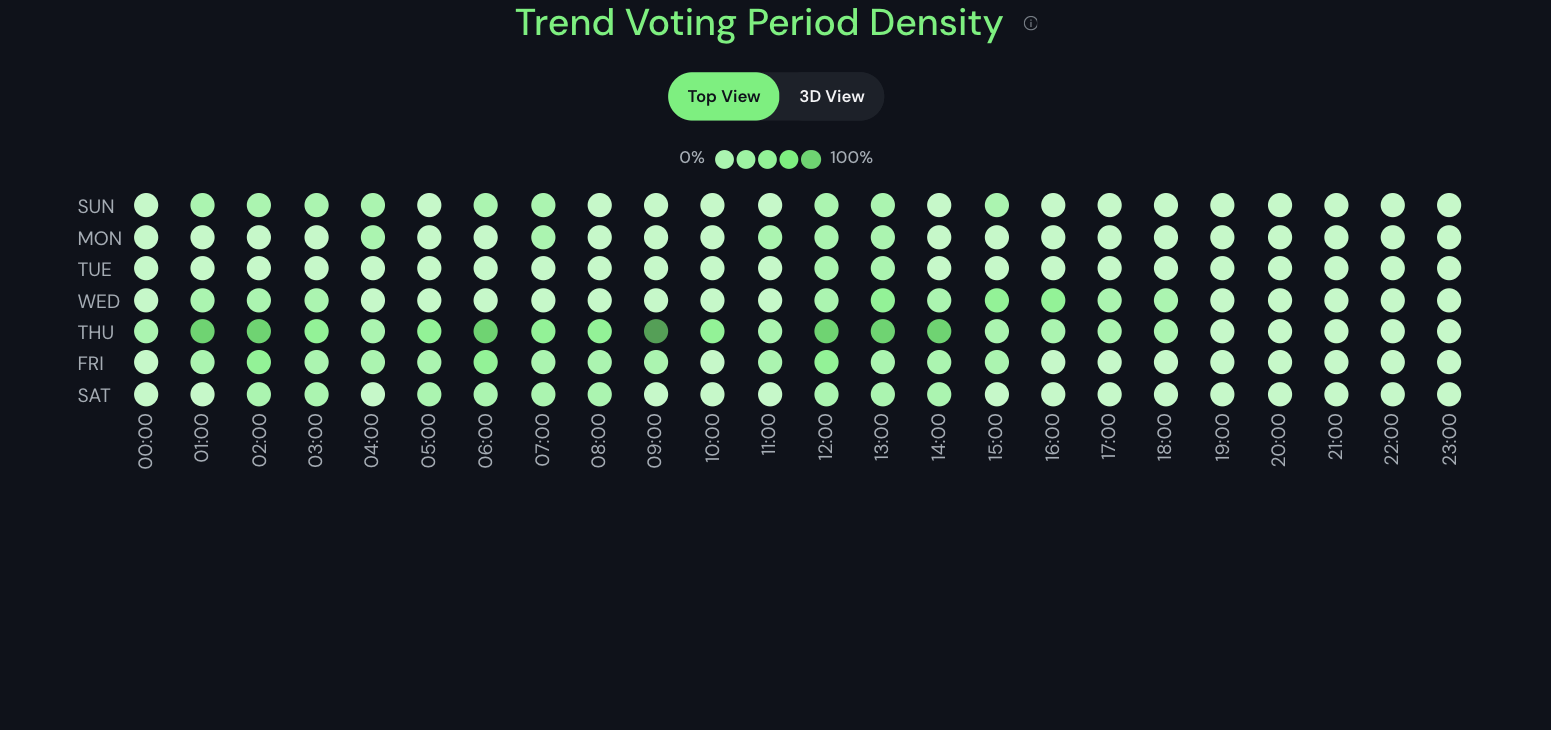
## **Trend Voting Period Density**:&#x20;

<div><figure><img src="/files/H89VZSxTcQJKRZxAB62I" alt=""><figcaption></figcaption></figure> <figure><img src="/files/u6rz18wU8dX02b2tNte4" alt=""><figcaption></figcaption></figure></div>

The colors on this heat map indicate voting density during various time periods. Darker shades signify higher voting density, scaled relative to the period with the highest density, which is represented by the darkest color.

## **Voting Momentum**:&#x20;

<figure><img src="/files/yawZufCbxOYOljj2Kryb" alt=""><figcaption></figcaption></figure>

Indicate the distribution of voter activity across the entirety of the proposals’ voting phase, divided into four equal quartiles: ‘early’, ‘normal’, ‘late’, and ‘ending’


---

# Agent Instructions
This documentation is published with GitBook. GitBook is the documentation platform designed so that both humans and AI agents can read, navigate, and reason over technical content effectively. Learn more at gitbook.com.

## Querying This Documentation
If you need additional information that is not directly available in this page, you can query the documentation dynamically by asking a question.

Perform an HTTP GET request on the current page URL with the `ask` query parameter:

```
GET https://docs-safedao.curiahub.xyz/metrics/voting-behavior.md?ask=<question>
```

The question should be specific, self-contained, and written in natural language.
The response will contain a direct answer to the question and relevant excerpts and sources from the documentation.

Use this mechanism when the answer is not explicitly present in the current page, you need clarification or additional context, or you want to retrieve related documentation sections.
